Articles
Stories
Same curriculum. Same teachers. Better writing.
How five InMAT primary schools raised Year 6 writing outcomes by 8.8 points in a single year, while the trust's other schools fell.

Dominic Bristow
Founder

Customer story · InMAT · 2025 to 2026
Most EdTech impact claims compare the amount pupils used a product with their outcomes, then credit the product for the correlation. If you've worked in schools, you'll have learned to be sceptical of those claims, and you're right to be.
Internally, at stylus, we call it 'The EdTech Effect': the pupils that get the best results are generally those who do the most work, regardless of what package they're using to do it.
But what if it's the teachers' usage of an educational service which correlates with improved pupil outcomes? Is that just a sign of supporting good teaching? We'd go even further in this case—we think it's a sign of professional development, too.
During 2025/26, five InMAT primary schools adopted stylus for Year 6 writing. They kept the same curriculum, the same timetable and the same teachers. The trust's other schools carried on as before. When the statutory Key Stage 2 writing results came in, InMAT's School Improvement Lead, Simon Blight, ran the numbers.
The results
In 2025 the two groups were level, with roughly three in four Year 6 pupils reaching the expected standard in writing.
A year later:
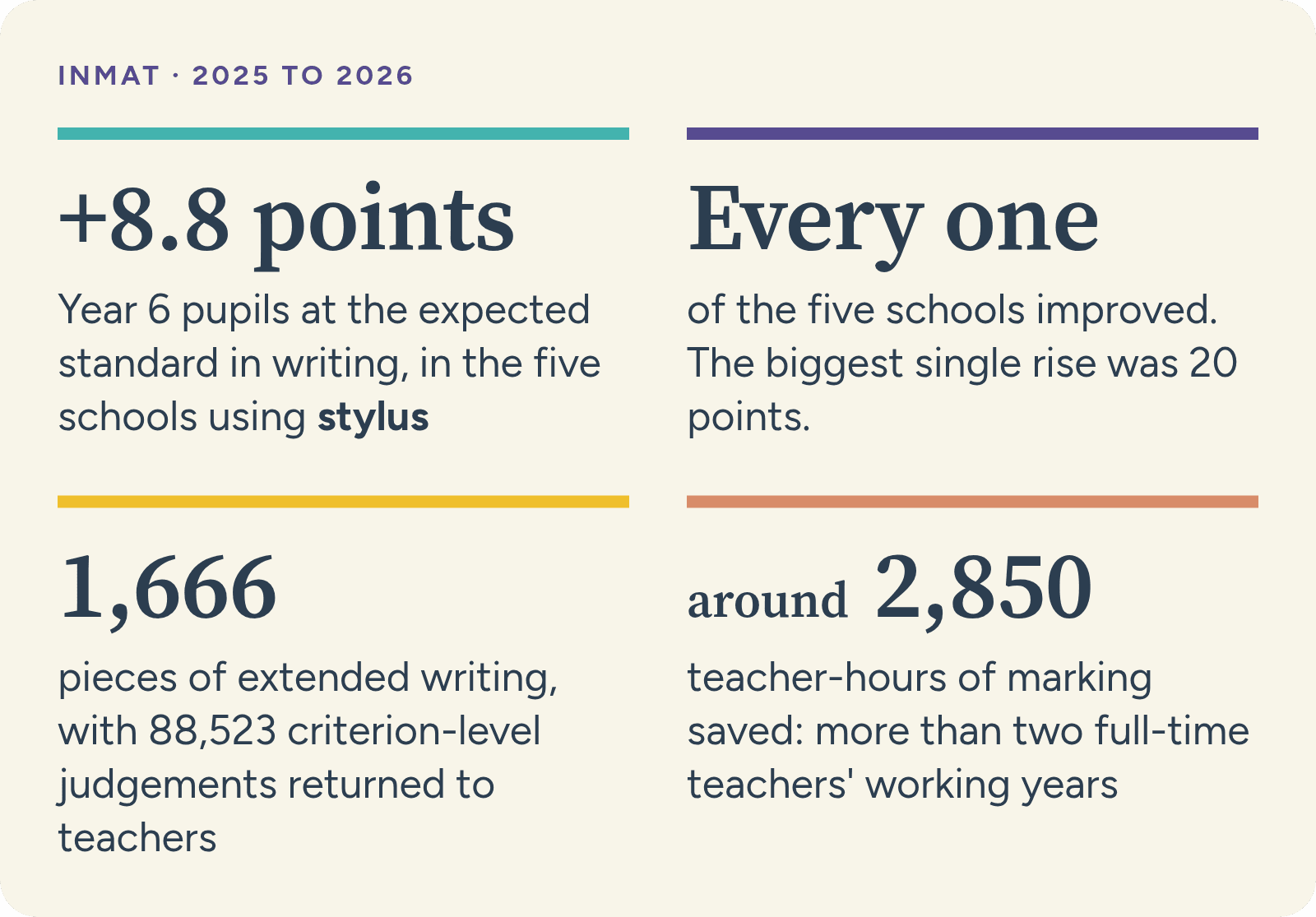
In the five schools using stylus, the share of Year 6 pupils at the expected standard rose from 74.8% to 83.6%, up 8.8 points.
In the trust's other schools, it fell from 72.75% to 70.0%, down 2.75 points.
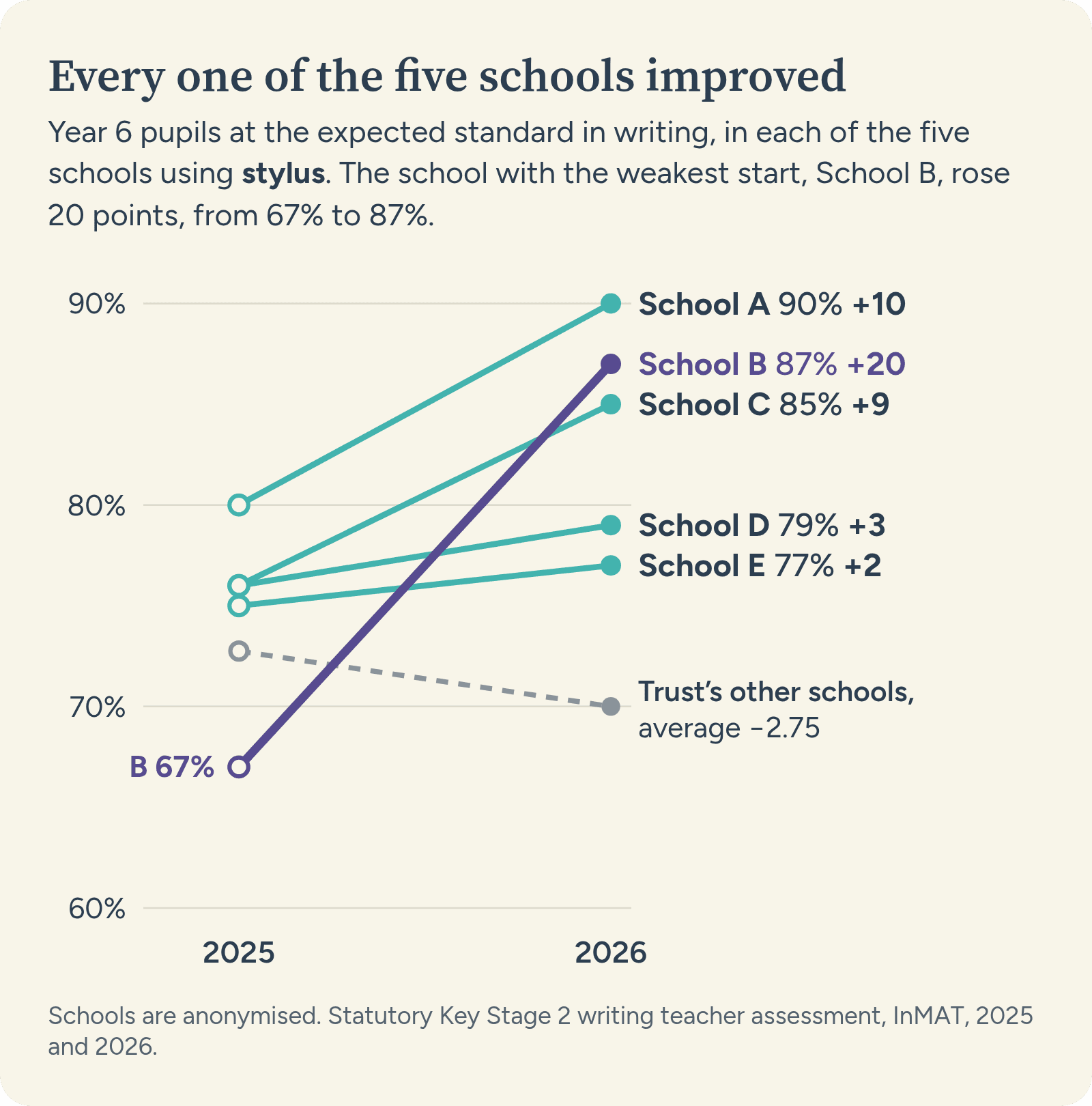
Every one of the five schools improved. The biggest single rise was 20 points.
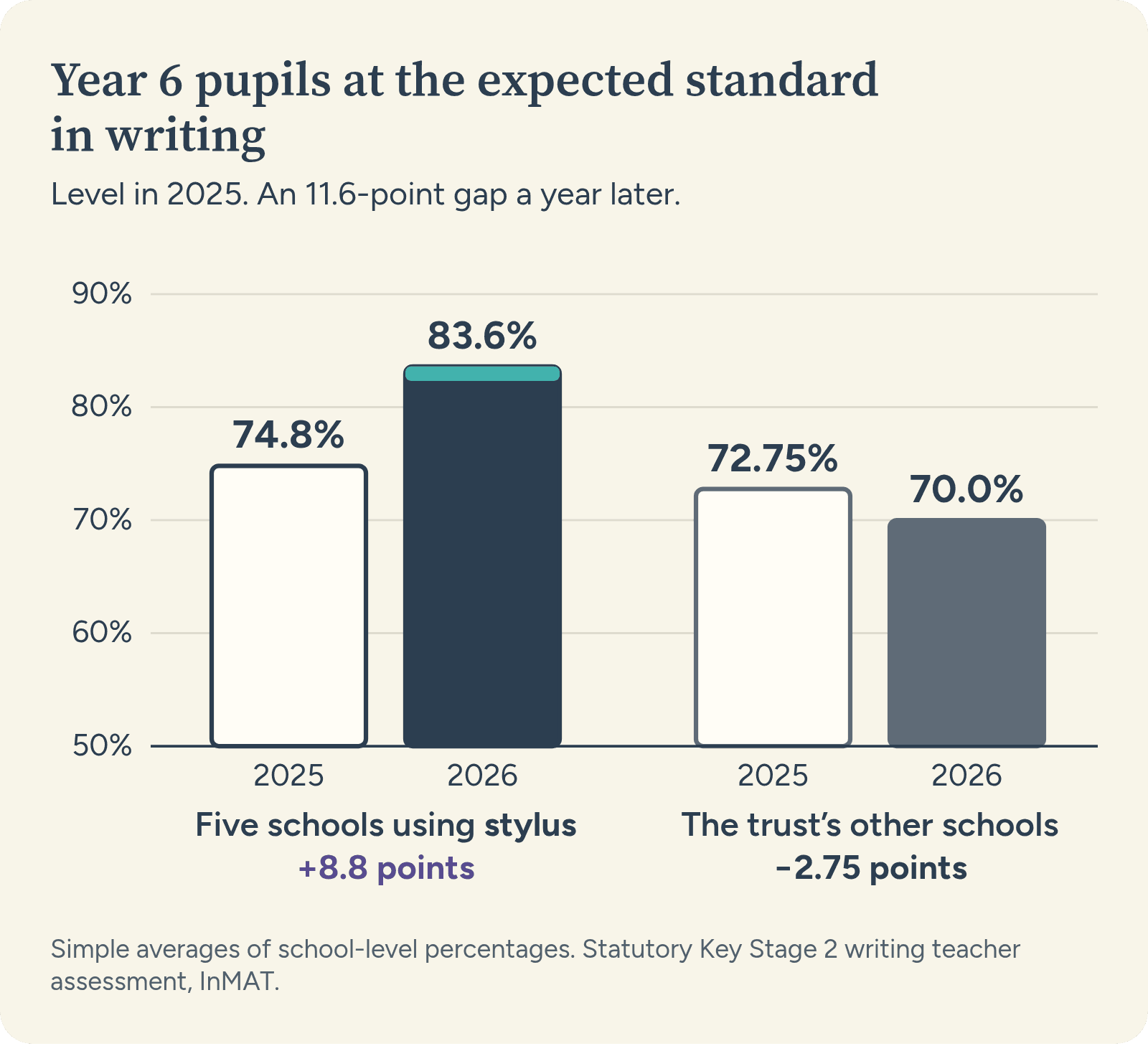
That opens up an 11.6-point gap in one year.
The school with the biggest rise had started with the weakest results of the five, at 67%. It finished at 87%, within three points of the strongest. In Simon's words: "The schools that had lower traditionally outcomes for writing, they've caught up with those better schools now. And the only thing we've done is given them stylus."
We'll be careful here, as InMAT is. Five schools is a strong association, not proof of cause. Every school has other things going on. But it's the pattern across the trust that matters, and the pattern is clear.
What the schools actually did
InMAT set out with four aims: remove the burden of marking extended writing, especially in Year 6; give teachers precise, trustworthy next steps for every pupil; begin to build consistency in writing across the trust; and raise outcomes.
It started with InMAT's curriculum, not ours. Our curriculum team mapped the trust's own primary writing framework onto the stylus sentence-level criteria, so every result came back in InMAT's terms. That work went on to change stylus for everyone: it's how the curriculum mapper that now lets any trust see results in its own framework came to be built.
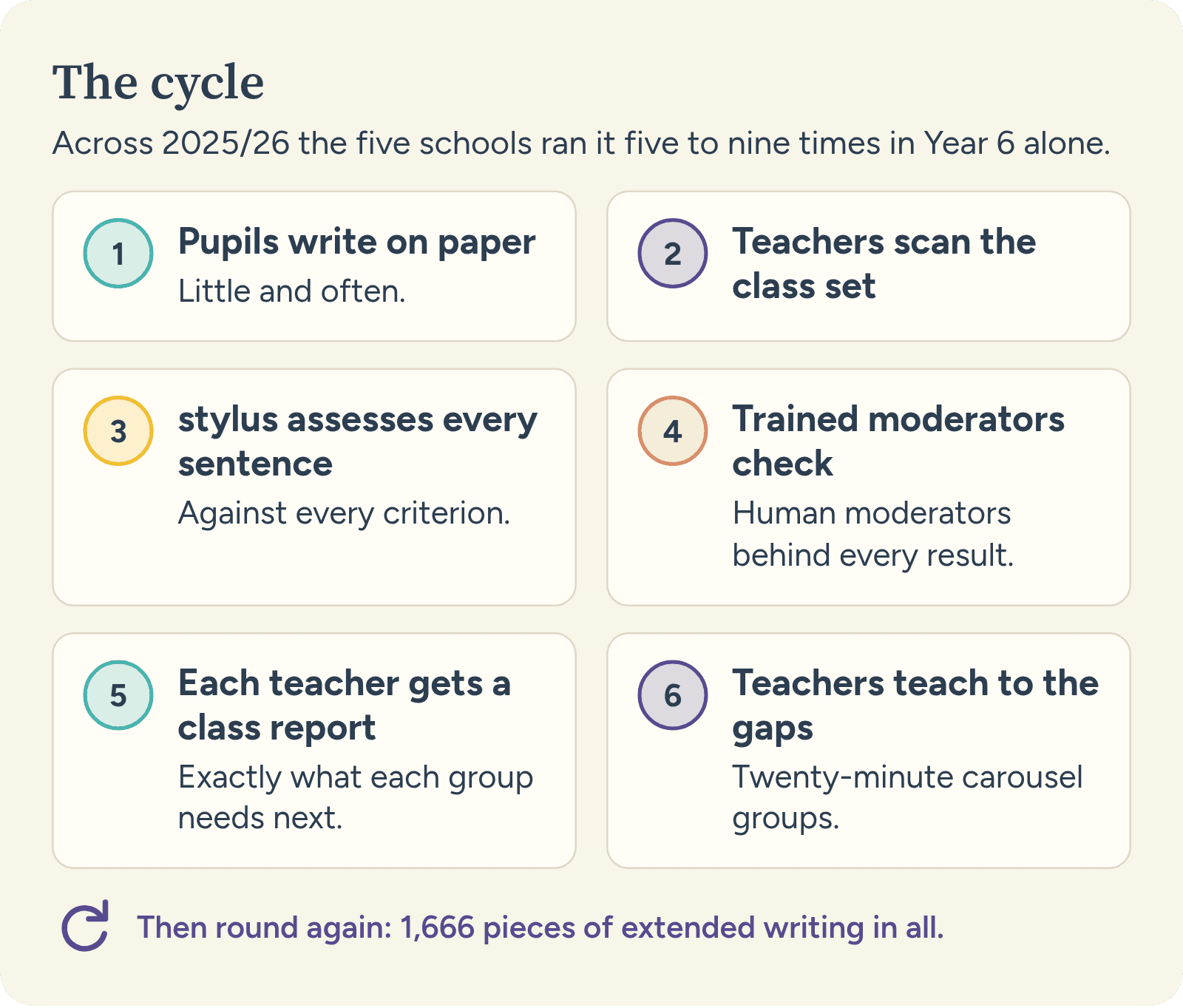
Pupils wrote on paper, little and often. Teachers scanned the class set. stylus assessed every sentence against every criterion, trained moderators checked the marking, and each teacher got a report on exactly what each group in the class needed next. Across 2025/26 the five schools ran this cycle five to nine times in Year 6 alone: 1,666 pieces of extended writing and 88,523 criterion-level judgements returned to teachers.
Teachers stopped marking and started teaching to the gaps. Simon's instruction to his writing leads was simple: "If stylus tells you, just teach it." Teachers used their class reports to run twenty-minute carousel groups, reteaching exactly the skill each group was missing.
The schools that engaged most improved most
This is the part we find most interesting, and most honest.
stylus isn't a silver bullet. Sending work in and receiving reports doesn't, on its own, improve anything. What changes outcomes is a teacher doing something different in the classroom.
When we looked at how often teachers used their stylus data in the run-up to Key Stage 2 assessment (adjusted for school size), the relationship with each school's improvement was striking. The school whose teachers used it most intensively in that period made the 20-point gain. Again, with five schools that's an association rather than proof. But it's exactly what we'd expect if the insight is only as good as what teachers do with it.
That's what we mean by "the stylus way": we do the assessment work, with human moderators behind every result, and teachers spend their time acting on it.
Workload, too
Classes wrote more than before, while teachers did none of the marking until final Year 6 portfolio assessment. Across the participating classes, InMAT saved around 2,850 teacher-hours of marking, more than two full-time teachers' working years returned to teaching. The DfE featured the work as a case study in its February 2026 schools white paper, Every child achieving and thriving.
What InMAT did next
The strongest measure of success is what a trust does next. InMAT has extended stylus to every Key Stage 2 pupil across the group, so there's now one moderated standard for writing across schools and year groups.
Helen Williams, InMAT's CEO, puts it simply: "It works for teachers, headteachers and leaders... no gimmicks, no snake oil, it just works."
Measuring ourselves in the open
One trust's results, however strong, are a starting point. When the 2026 Key Stage 2 data is published, we'll run the same analysis across our other schools that meet a clear engagement threshold, and we'll share what we find, not just the good bits.
If you lead writing or school improvement in a trust and you'd like to see what this could look like in your schools, book a 30-minute conversation with our Director of Schools, Hannah Gillott.
Outcome data was supplied by InMAT's School Improvement Lead from statutory Key Stage 2 writing teacher assessment, 2025 and 2026. Usage data comes from stylus platform records for 2025/26. Averages are simple averages of school-level percentages. Individual schools are not named.
Dominic Bristow
Founder
Share